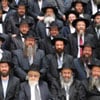
EDISON, N.J.—The New Jersey Convention and Exposition Center has hosted the gala banquet of the International Conference of Chabad-Lubavitch Emissaries for years now, and every year the room has somehow found more space. This year it quite nearly ran out. Some 6,500 shluchim and their guests filled the 150,000-square-foot hall to capacity on Sunday afternoon. Tables pressed to the walls, the mood in the hall was one of joy, celebration and responsibility, as the frontier keeps moving forward.
The banquet closed out the 43rd International Conference of Chabad-Lubavitch Emissaries (Kinus Hashluchim), the culmination of five days of workshops and study, prayer and reunion, that drew Chabad emissaries from more than 100 countries and every U.S. state.
Long before the first course, the event had already begun for tens of thousands watching the live broadcast across time zones. A pre-show highlighted Chabad’s partnership with Park East Synagogue and sat down with emissaries who had made the trek, among them Rabbi Yehoram Ulman of Sydney, who spoke about what the past year has looked like in the wake of the Bondi Chanukah attack, where he lost his assistant rabbi and son-in-law, Rabbi Eli Schlanger.
Inside the hall, the program opened with a choir of emissaries’ sons singing in English, Hebrew and Spanish, a small sampling of the languages their parents work in every day.
Rabbi Mendy Kotlarsky, executive director of Merkos 302, welcomed the emissaries, lay leaders and guests, and reached for the patriarch whose story had been read in synagogues that very Shabbat.
“Abraham’s entire existence became dedicated to generating goodness,” he said. “People who do not simply perform acts of kindness but establish a presence through which kindness and holiness continue to flow; day after day, year after year, generation after generation. That was Abraham, and that is the charge of every emissary sitting in this room and around the world.”

The thread of the afternoon gala was spun early. A film marking 50 years since the Rebbe launched Mivtza Chinuch, his campaign for Jewish education, set the theme, and the Psalms that followed were entrusted to teachers: Rabbi Chaim Yitzchok Sanowicz of Yeshivah Ohr Elchonon Chabad in California led Chapter 125; Rabbi Menachem Levy of Cheder Lubavitch in Nice, France, Chapter 126; and Rabbi Avi Shlomo of the Jewish International School of Cape Town, South Africa, Chapter 120.
That thread ran straight back 70 years in a video greeting from Rabbi Yehuda Krinsky, who served as a secretary to the Rebbe, Rabbi Menachem M. Schneerson, of righteous memory, for four decades and as chairman of Merkos L’Inyonei Chinuch, the educational arm of the Chabad-Lubavitch movement. Krinsky recalled April 1956, when the Rebbe dispatched him and a delegation of yeshivah students to Kfar Chabad, Israel, where terrorists murdered five students and their teacher. The terms of the mission, he said, have stayed with him ever since.
“He did not send us to speak about the terrorists, about terrorism. He did not discuss antisemitism with us, or tell us to talk about it,” Krinsky said. “He sent us to speak about Torah and Yiddishkeit, about the future of Jewish life. The Rebbe understood that the most effective response to those who seek to destroy Jewish life is to build it stronger, with deeper roots and a livelier reality.”
Krinsky asked the emissaries to carry that response forward, and said he sees it embodied in them already and in the Jewish pride, the ge’on Yaakov, that their work inspires.
The room was about to see what he meant. The screen turned to Scottsdale, Ariz., and to Nosson Schlanger, son of the murdered emissary Rabbi Eli Schlanger, now a student in yeshivah there. The film followed the boy through the rhythms his father had set: learning Tanya with a study partner, as the two of them once did together; heading out on weekly mivtzoim, as his father had.

“The biggest thing I learned from my father is how much happiness there is in being the Rebbe’s shliach,” he explains in the film.
Then as the young Schlanger walked in the hall rose to its feet, and the applause did not stop.

He recalled to the crowd his memories of accompanying his father on house visits, and about the day his father said about him: “He isn’t just the son of a shliach; he is a shliach himself.” Joining him on the stage was his grandfather, Rabbi Ulman, who embraced him and spoke briefly of his pride in his grandson’s work.
From a son carrying his father’s mission forward, the evening widened to a movement that had done the same under harsh conditions. A film traced Chabad’s underground work behind the Iron Curtain, led by the Sixth Rebbe, Rabbi Yosef Y. Schneersohn, to the Rebbe after him—and landed on one of its ate fruits: Rabbi Alex Kaller, director of the Chabad Russian Center of South Florida.
Kaller was born in Moscow in 1976, the only Jew in his class, raised in a home that was fiercely proud and entirely unobservant, and beaten up for being Jewish all the same. When the Soviet Union cracked open, a Jewish school opened in Moscow, and he remembered walking in for the first time and feeling something he had never felt. “Like I was lifted up,” he said.

He sang the blessings for the menorah at the 1990 Chanukah Live broadcast as the Rebbe watched, representing Russian Jewry, and by the time he finished his studies at the Chabad yeshivah in London he had decided not only to become an emissary but to become one for the Russian Jewish expatriate community. In 1999 he visited Miami, asked a local whether the city had a Russian-speaking rabbi, was told it did not, and picked up the phone to Rabbi Avraham Korf, telling him: “You need me.”
This year Kaller and his wife, Chanie, celebrated the opening of the Chabad Russian Center of South Florida’s 39,000 square foot Leizer Verbukh Jewish Community Center in Sunny Isles Beach.
Kaller then took the stage himself and shared the remarkable circumstances of his journey and of his disbelief in his standing there today.
Planting was also the word the Rebbe had used, decades earlier, for a very different field. A film on Chabad’s work in Italy, begun in 1958, introduced Rabbi Aharon Michoel Canarutto, now of Chabad of the Jewish Ghetto in Rome—himself one of the seeds, a child whose parents attended Chabad programs and who was, by his own account, “a fully fledged Lubavitcher by his bar mitzvah.”
The film carried one story that silenced the room. In 1943, a Jewish boy, Gabriel Sonnino, and his sister slipped out of their parents’ hiding place in a car in the Roman Ghetto to play in the street. A German soldier appeared, seized the girl and began dragging her away, until a non-Jewish milkman burst from his storefront, grabbed the child back, and tore open his shirt to show the soldier the cross on his chest. The German let her go. Years later, Sonnino told Canarutto where that milkman’s shop had stood: on the very spot where the Chabad center now stands.
Canarutto, taking the stage, drew the parallel himself of emissaries bringing light into the places where darkness once ruled.
A film surveying the emissaries’ activity in the land of Israel—north to south, hospital wards to soup kitchens—gave way to Israel’s ambassador to the United States, Yechiel Leiter. Leiter spoke of life in the Holy Land and of his son Neria, seriously wounded in a car-ramming attack in September.
By the time Kotlarsky returned to the podium, the theme had been set. Chinuch—Jewish education—will be the mission of the coming year, which marks a century since the Sixth Rebbe’s liberation on 12 Tammuz. Kotlarsky unveiled the Chabad Education Fund, a new tuition-scholarship initiative to put Jewish day school within reach of families who cannot afford it, together with the Chinuch Center, the first dedicated resource and training center for Jewish educators to be built in Crown Heights. Around those two anchors he laid out a dozen initiatives for the year ahead, several aimed squarely at children and teens.

And still the map keeps filling in. During the iconic roll call, among the new postings announced from the stage was one that colors a blank spot in Europe: Rabbi Yosef and Rochele Krinsky will move to Ljubljana as the first dedicated Chabad-Lubavitch emissary couple to Slovenia. Until now the small Alpine nation—home to fewer than a hundred Jews and, each summer, tens of thousands of Israeli tourists—has been served from across the Italian border by Chabad of Trieste. Additionally, Albania will also get its first Chabad emissaries.
The tables then emptied as thousands flooded to the empty spaces, spilling out in dancing and celebration. By Monday they would be scattered again to more than 100 countries and all 50 U.S. states, but as of Sunday evening, they danced together as one, with renewed excitement and energy to their respective missions, carrying home with them the resolutions and inspiration of the last five days.
Photos by Yisroel Teitelbaum / Chabad.org